
What effective sterilization must achieve
Sterilizing stainless steel instruments begins well before a tray is placed in a steam sterilizer. In healthcare settings, the practical target is to return a reusable device to a condition that is safe for its next intended use, using a process validated for that instrument, sterilizer, and packaging system. For most critical stainless steel surgical instruments that can tolerate heat and moisture, steam sterilization remains the preferred method in U.S. infection control guidance. Steam, however, cannot correct poor cleaning, dried soil, unsuitable detergent chemistry, damaged surfaces, or missing monitoring records.
A reliable process covers the full reprocessing pathway: point-of-use treatment, transport, cleaning, rinsing, drying, inspection, packaging, sterilization, monitoring, release, and storage. This article focuses on reusable stainless steel instruments used in clinical environments. For broader device and tool topics, see the Instruments section.
Classify the instrument before choosing the process
The first question is not which autoclave cycle is convenient. It is how the instrument will be used on the patient. CDC guidance follows the widely used risk-based approach: critical items that enter sterile tissue or the vascular system require sterilization before use on each patient; semicritical items that contact mucous membranes or nonintact skin require at least high-level disinfection; noncritical items that contact intact skin usually need low-level disinfection.
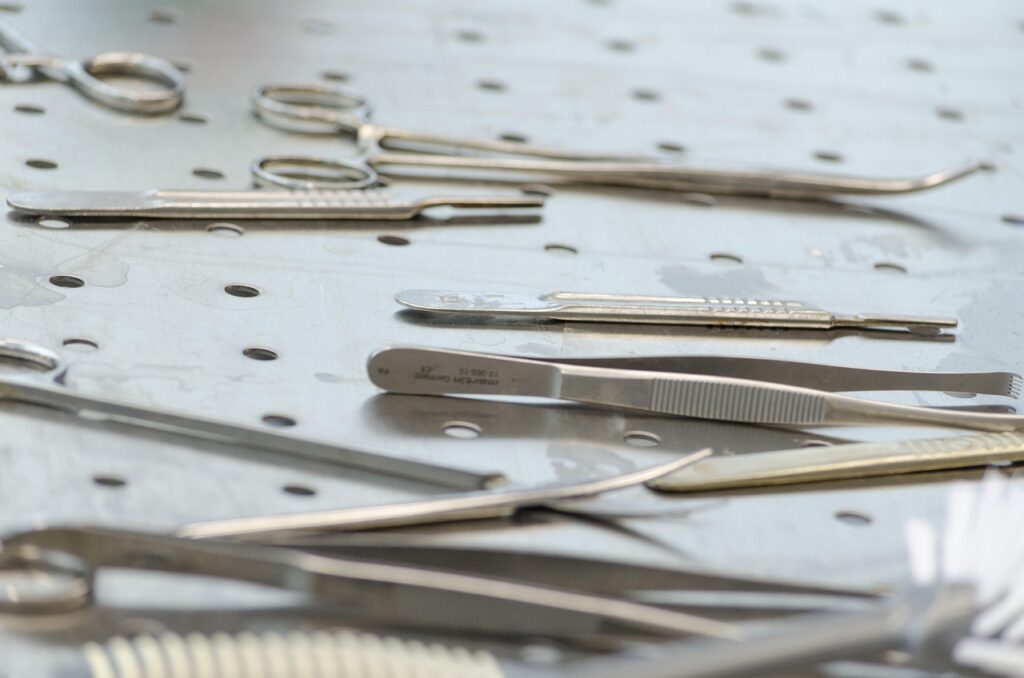
Many stainless steel forceps, scissors, retractors, clamps, curettes, elevators, and other surgical instruments are critical devices when used in invasive procedures. For these instruments, sterilization is the endpoint, but it is not a standalone event. FDA information on reusable medical devices describes reprocessing as a multistep activity that removes blood, tissue, and other debris and then inactivates microorganisms so the device can be safely reused. That distinction is important because retained soil can shield microorganisms from the later sterilization step.
Instrument construction also matters. Stainless steel is durable, but it is not indestructible. Hinges, box locks, serrations, lumens, insulation, coatings, and mated surfaces can make cleaning harder than the word stainless suggests. The manufacturer’s instructions for use should control the cleaning method, permitted chemistry, disassembly requirements, lubrication instructions, packaging, and sterilization parameters.
The workflow from point of use to sterile storage
A defined workflow is easier to train, monitor, and audit than a set of local habits. The table below summarizes the main control points used in sterile processing departments and ambulatory care settings.
| Stage | Primary control point | Why it matters |
|---|---|---|
| Point of use | Remove gross soil and keep instruments moist when required by policy and IFU. | Dried blood, tissue, and salts are harder to remove and can reduce the effectiveness of later sterilization. |
| Transport | Contain contaminated devices and protect staff from exposure. | Transport should prevent cross-contamination, sharps injuries, and drying of soil during delays. |
| Cleaning | Use manual or mechanical cleaning according to IFU, including brushes, ultrasonic cleaning, or washer-disinfectors when appropriate. | Cleaning removes organic and inorganic material that can block sterilant contact. |
| Rinsing and drying | Remove detergent residue and dry instruments before inspection and packaging. | Residue and retained moisture can affect materials, packaging, and sterilization outcomes. |
| Inspection | Check cleanliness, function, corrosion, damage, insulation, alignment, and sharpness. | Damaged or uncleanable instruments should be removed from service rather than sterilized and returned. |
| Packaging and loading | Use compatible wraps, pouches, trays, or rigid containers and load according to sterilizer and container instructions. | Sterilant must reach all surfaces, and the sterile barrier must protect the item after processing. |
| Sterilization and release | Run the validated cycle and review mechanical, chemical, and biological monitoring as required. | Release decisions should be based on documented evidence, not visual appearance alone. |
Cleaning determines whether sterilization can work
CDC recommendations emphasize that medical devices should be meticulously cleaned before high-level disinfection or sterilization. This is especially important for stainless steel instruments because visible soil is only part of the problem. Proteins, salts, mineral deposits, lubricants, and detergent residues can remain in joints or textured surfaces. Complex instruments may need disassembly, specific brushes, flushing, ultrasonic cleaning, or repeated inspection under lighted magnification.
For stainless steel, cleaning chemistry must be compatible with the alloy and with any coatings or inserts. Neutral or near-neutral pH detergents are often used because they balance soil removal with material compatibility, but the IFU should decide. Strongly acidic, strongly alkaline, abrasive, or chloride-containing materials can damage instrument surfaces. AORN educational guidance has highlighted that chloride exposure and poor water quality can contribute to pitting corrosion on stainless steel. Once pitting occurs, the surface can become harder to clean and may trap soil.
Water quality is another practical variable. Hard water and inadequate rinsing can leave deposits that look like staining or corrosion. Residual detergent can interfere with processing and irritate tissue if it remains on a device. Facilities should define which water quality is required for each stage, particularly final rinse, steam generation, and cleaning equipment, using device IFUs and applicable standards.
Choosing the sterilization method for stainless steel instruments
Steam is generally the first-choice method for critical stainless steel instruments that can tolerate heat, pressure, moisture, and the selected packaging system. It is efficient, widely available, and well supported by healthcare guidance. The correct cycle, however, is not universal. Time, temperature, drying time, packaging, load configuration, and sterilizer type must match the sterilizer manufacturer’s instructions, the device IFU, and the container or wrap instructions.
Low-temperature methods, such as ethylene oxide or hydrogen peroxide-based systems, may be needed for devices that are heat- or moisture-sensitive, or for stainless steel instruments combined with electronics, insulation, adhesives, optics, or materials that cannot tolerate a standard steam cycle. The fact that a device includes stainless steel does not automatically mean the entire device is steam compatible.
Immediate-use steam sterilization should be treated as an exception rather than a routine inventory strategy. It may be necessary for an urgently needed item, but it creates tighter controls around cleaning, transport, monitoring, and aseptic transfer. Repeated reliance on immediate-use cycles can point to deeper operational issues, such as insufficient instrument inventory, poor scheduling, or repair delays.
Monitoring, release, and documentation
Sterilization monitoring should combine several types of evidence. Mechanical monitoring verifies cycle data such as time, temperature, and pressure. Chemical indicators show that a package or location was exposed to certain sterilization conditions, but they do not prove that sterilization was achieved. Biological indicators provide a more direct challenge to the process because they use resistant spores to test microbial lethality.
CDC guidance describes routine monitoring with mechanical, chemical, and biological indicators. It also notes that internal and external chemical indicators should not be used if they suggest inadequate processing, and that a Bowie-Dick air-removal test is performed daily in an empty dynamic-air-removal steam sterilizer. Implant loads require especially careful control; guidance commonly calls for biological monitoring of loads containing implantable objects, with release managed according to facility policy and applicable standards. See also: Implants.
Documentation should connect the instrument set, sterilizer, cycle, operator, load contents, indicators, and release decision. Records are not simply paperwork. They allow a facility to respond if a sterilization failure is discovered, a biological indicator is positive, a wet pack is found, or an instrument must be traced after patient use. Retention periods should follow facility policy, accreditation requirements, state rules, and federal requirements where applicable.
Common mistakes that put instruments and patients at risk
Most sterilization failures are not dramatic equipment breakdowns. More often, they are workflow failures that repeat quietly. Common risks include:
- Allowing blood or tissue to dry on instruments before decontamination.
- Skipping disassembly or brushing steps required by the device IFU.
- Using household cleaners, saline, bleach, or other incompatible chemistry on stainless steel instruments.
- Overloading trays so steam, detergent, rinse water, or drying air cannot reach surfaces.
- Packaging instruments before they are dry and fully inspected.
- Assuming a color change on external tape proves sterility.
- Returning pitted, cracked, misaligned, or uncleanable instruments to service.
- Using one generic cycle for all stainless steel devices without checking IFUs.
- Treating immediate-use steam sterilization as a substitute for adequate inventory.
The corrective action is usually system-based: better point-of-use practices, accessible IFUs, staff training, water quality review, preventive maintenance, instrument repair, and audit-ready documentation. Sterile processing should be managed as a quality system, not as an isolated technical task.
What to watch as standards evolve
As of October 2026, major U.S. references for this topic include CDC disinfection and sterilization recommendations, FDA reprocessing guidance for reusable medical devices, ANSI/AAMI ST79:2017 reaffirmed in 2022 with 2020 amendments, and AORN guidance on care and cleaning of surgical instruments. AAMI has also described an active revision process for ST79, with modernization and clarification among the stated goals. That does not replace current facility policy overnight, but it does signal that sterile processing leaders should keep standards review on the calendar.
For manufacturers, validated labeling is central. FDA guidance expects reusable device reprocessing instructions to be scientifically supported and understandable for healthcare users. For healthcare facilities, the operational challenge is different: make sure staff can access the right IFU, own the correct accessories, use compatible detergents and sterilizers, and document that the process was followed. A validated instruction that cannot be implemented in the facility is both a patient safety problem and an equipment planning problem.
Frequently asked questions
Can stainless steel instruments always be autoclaved?
No. Many stainless steel surgical instruments are compatible with steam sterilization, but compatibility depends on the complete device design and IFU. Instruments with insulation, coatings, electronics, optics, adhesives, or complex lumens may require specific cleaning and sterilization conditions or a low-temperature process.
Is cleaning necessary if the instrument will be sterilized?
Yes. Cleaning is essential because organic and inorganic material can block sterilant contact. Sterilization should be viewed as the final validated step after soil removal, rinsing, drying, inspection, and proper packaging.
What causes rust, staining, or pitting after sterilization?
Possible causes include chloride exposure, poor water quality, retained detergent, incompatible chemicals, insufficient rinsing, instrument damage, wet storage conditions, or contact with dissimilar metals. Staining should be investigated rather than ignored, because true pitting or corrosion can make an instrument harder to clean.
Are chemical indicators enough to release a load?
No. Chemical indicators are useful, but they are only one part of monitoring. A complete release process considers mechanical cycle data, chemical indicators, biological indicators when required, load contents, packaging integrity, dryness, and facility policy.
Can single-use stainless steel instruments be reprocessed?
Not simply because they are made of metal. Single-use devices should not be reprocessed by a facility unless the activity is allowed under applicable regulatory requirements and supported by validated procedures. Reusable and single-use labeling should be treated as a regulatory and safety distinction, not as a material preference.