
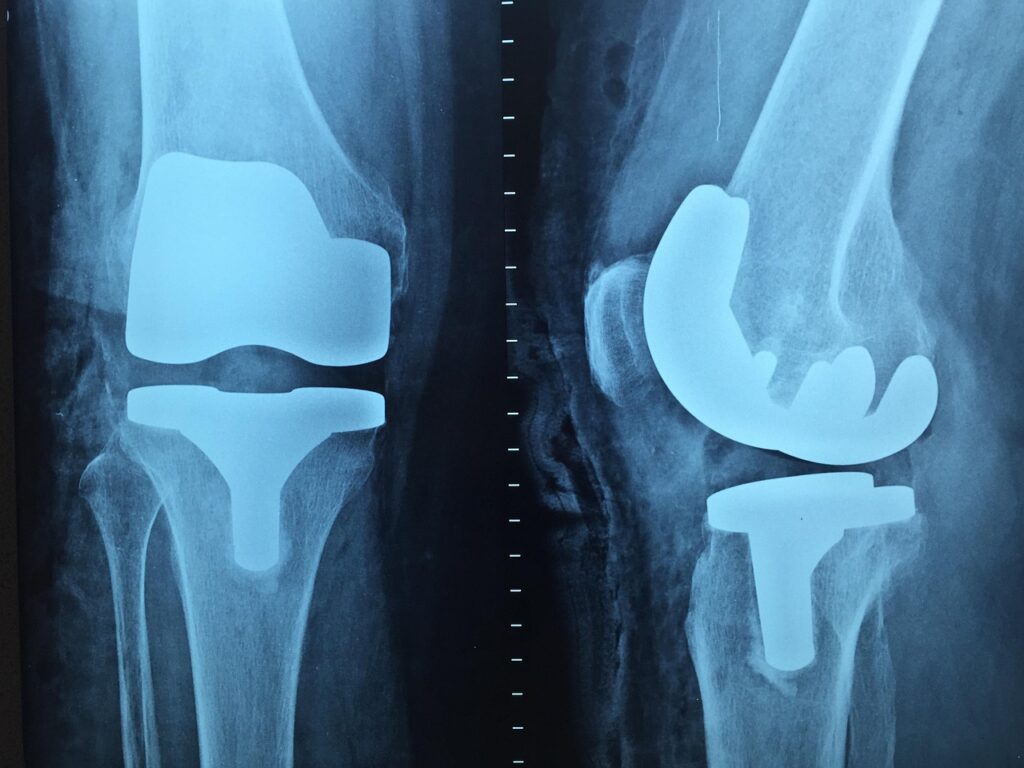
Why orthopedic implants matter in modern care
Orthopedic implants are medical devices used to replace damaged joint surfaces, stabilize fractured bones, correct deformity, or support musculoskeletal structures while healing occurs. Their performance depends on more than the device itself. Clinical indication, bone quality, surgical technique, material choice, fixation method and follow-up all influence outcomes.
Public information from the U.S. Food and Drug Administration, AAOS OrthoInfo, the CDC and the American Joint Replacement Registry points to a consistent conclusion: modern implants are not selected by brand alone. They are chosen through a risk-benefit decision that weighs mechanical demands, biological response, patient factors, premarket testing and real-world evidence. For more coverage of implant-related topics, visit the Implants section.

Main categories of orthopedic implants
The term orthopedic implant covers several device families. Some are intended to remain in the body for decades. Others may be removed after bone healing or revised if the underlying disease progresses. Hip and knee replacement components are the most familiar examples, but the category also includes plates, screws, rods, intramedullary nails, spinal constructs and specialty devices used in trauma, deformity correction and reconstruction.
Joint replacement implants are designed to restore smoother movement when cartilage and bone have been damaged by osteoarthritis, inflammatory arthritis, trauma or other conditions. The CDC states that about 33 million U.S. adults have osteoarthritis, and joint replacement surgery may be considered when conservative treatments have not worked. That disease burden helps explain why hip and knee arthroplasty data are closely tracked in national registries.
| Implant category | Common examples | Primary purpose |
|---|---|---|
| Joint reconstruction | Total hip, total knee, partial knee, shoulder components | Replace damaged joint surfaces and restore alignment or motion |
| Fracture fixation | Bone plates, screws, washers, rods and nails | Hold bone fragments in position during healing |
| Spine and deformity correction | Screws, rods, cages and interbody devices | Stabilize, align or support spinal structures in selected cases |
| Specialty reconstruction | Revision systems, tumor reconstruction devices and custom or patient-matched components | Address bone loss, complex anatomy or failed prior implants |
It is useful to separate an implant’s function from its shape. A screw may look simple, but it is still a regulated device that must withstand repeated load. A hip replacement cup may look like a shell, yet its surface, liner, bearing couple and fixation interface all affect performance.
Materials used in orthopedic implants
Orthopedic implant materials must meet competing requirements. They need enough strength for weight-bearing loads, sufficient corrosion resistance for long-term exposure to body fluids, and biocompatibility to reduce the risk of adverse tissue response. The FDA describes metals, polymers and ceramics as common materials used in medical devices, including devices that may remain in contact with the body for extended periods.
Common metallic materials include titanium and titanium alloys, cobalt-chromium alloys and surgical stainless steel. FDA guidance for non-spinal bone plates, screws and washers identifies titanium alloy, commercially pure titanium, stainless steel, cobalt-chrome alloy and PEEK among examples used in orthopedic fixation devices. These materials are not interchangeable. Titanium alloys are often valued for corrosion resistance and a modulus closer to bone than some other metals. Cobalt-chromium alloys are commonly associated with high wear resistance. Stainless steel remains important in fixation devices, particularly where its mechanical profile and surgical handling are appropriate.
Polymers also play a central role. In knee replacement, AAOS OrthoInfo describes medical-grade polyethylene as the plastic bearing surface that allows metal components to articulate with less wear than metal-on-metal contact. In hip replacement, the ball may be metal or ceramic, while the socket may use a polyethylene liner inside a metal shell. Ceramics are used where hardness, scratch resistance and wear performance are important, but selection still depends on the full implant design and clinical context.
- Metals provide strength, toughness and structural support in high-load environments.
- Polyethylene is widely used as a bearing material in hip and knee replacement.
- Ceramics may reduce wear in selected bearing combinations, especially in hip arthroplasty.
- PEEK and related polymers may be used in certain fixation or spine applications, depending on indication and regulatory clearance.
Material selection also has a patient-specific dimension. People with known allergy or sensitivity to cobalt, chromium or nickel should tell their surgeon before joint replacement. AAOS notes that no single test is widely accepted for predicting metal implant hypersensitivity or implant failure, so history, symptoms and implant choice must be interpreted clinically rather than mechanically.
Fixation methods and why they are debated
Fixation describes how an implant connects to bone. In joint replacement, the main approaches are cemented fixation, cementless fixation and hybrid fixation. Cemented fixation uses bone cement, commonly polymethylmethacrylate, to anchor components. Cementless fixation depends on initial mechanical stability followed by bone ingrowth into a porous or textured surface. Hybrid fixation combines both strategies in the same reconstruction, such as one cemented component and one press-fit component.
AAOS OrthoInfo describes all three methods in knee replacement and notes that hip components may be press-fit, cemented, or used in combination depending on factors such as bone quality and strength. Fixation is therefore not a simple newer-versus-older decision. Cemented fixation can be appropriate when immediate fixation is preferred or bone quality is a concern. Cementless fixation may be selected when bone ingrowth is expected to provide durable biological fixation. Hybrid methods can balance those considerations.
Registry data add important context. The 2024 American Joint Replacement Registry report highlighted that cementless fixation accounted for 21.8% of primary total knee arthroplasty in 2023, while cemented fixation still predominated. The 2025 AJRR Annual Report, available in 2026, captured more than 4.6 million hip and knee procedures performed from 2012 through 2024 and included submissions from all 50 U.S. states. Those figures do not prove that one fixation strategy is best for every patient. They do show how practice patterns can be measured at scale rather than inferred from marketing claims or isolated experience.
The practical takeaway is that fixation should be judged by indication, anatomy, bone quality, implant design, surgeon experience and long-term evidence. A cementless knee implant may be attractive for one patient and inappropriate for another. A cemented stem may be prudent in a low-bone-density case. The evidence question is not only whether the implant can bond to bone, but whether the chosen construct reduces revision risk and supports function over time.
How safety and performance are evaluated
Orthopedic implants are evaluated before and after market entry. In the United States, FDA device classification is risk based. The agency has established classifications for roughly 1,700 generic device types grouped into 16 medical specialty panels. If a Class I or Class II device is not exempt, a 510(k) submission is generally required for marketing. Class III devices usually require premarket approval unless a specific exception applies. For implants, the pathway depends on intended use, indications, technological characteristics and risk.
Premarket evidence may include mechanical testing, fatigue testing, wear assessment, corrosion evaluation, sterilization validation, packaging validation, biocompatibility assessment and comparisons with predicate devices. FDA materials guidance emphasizes a risk-based approach to biocompatibility, considering device materials, manufacturing processes, anatomical location and duration of body contact. For a load-bearing implant, engineering performance is not background information; it is central to whether the device can meet its intended function.
Regulatory clearance should not be read as a claim that a device is superior to all alternatives. A 510(k) decision is tied to substantial equivalence and intended use, while premarket approval is a different pathway for higher-risk devices. Clinicians and hospitals still need to consider published studies, registry trends, revision data, warnings, recalls and patient-specific factors when evaluating an implant family.
Postmarket evidence is especially important because many implant questions only become clear after years of use. Registries can track procedure volume, implant utilization, revision burden, reasons for revision and patient-reported outcome measures. The 2025 AJRR report also emphasized work to improve data completeness and standardize robotics data capture. That infrastructure matters because modern orthopedic care increasingly depends on long-term evidence, not only short-term technical success. See also: Fixation.
Known risks and monitoring considerations
No orthopedic implant is risk-free. Potential complications include infection, inflammatory reaction, loosening, instability, fracture, dislocation, wear debris, implant breakage, nerve or vessel injury, pain, stiffness and the need for revision surgery. The risk profile differs by joint, device type, patient health, surgical indication and follow-up period. A trauma plate used to stabilize a fracture raises different concerns from a total hip bearing surface expected to move through millions of cycles each year.
Metal-on-metal hip implants remain an important safety lesson. The FDA states that a final order in February 2016 required premarket approval applications for certain metal-on-metal total hip replacement devices, and that the requirement became effective in May 2016. FDA public information currently states that there are no FDA-approved metal-on-metal total hip replacement devices marketed for use in the United States, while two FDA-approved metal-on-metal hip resurfacing devices are available. This history illustrates why bearing surface selection, wear debris and postmarket surveillance matter.
Patients with older implants should not assume they have a problem, but they should maintain routine follow-up according to their surgeon’s advice. New pain, swelling, reduced function, instability, fever, wound problems, neurologic symptoms or unexplained changes around an implant warrant professional evaluation. For people with metal-on-metal hip implants, FDA and orthopedic society materials describe additional follow-up considerations, including imaging or metal ion testing in selected cases.
For industry readers, the key lesson is that safety is not a single checkpoint. It begins with design controls and material selection, continues through testing and regulatory review, and remains active through registries, adverse event reporting, surgeon feedback and revision analysis.
What to watch in implant development
Orthopedic implant innovation is moving in several directions, but the strongest developments are evidence-driven rather than slogan-driven. Additive manufacturing can create porous structures and complex geometries, but unique geometries or surface modifications may require additional regulatory discussion and testing. Robotics and navigation may improve the precision of component placement, but registry-level data are still needed to understand how those technologies affect revision risk, patient-reported outcomes and cost over time.
Surface technology is another active area. Porous coatings, grit blasting, plasma spray, hydroxyapatite coatings and other surface strategies aim to improve fixation or biological response. A surface that looks promising in concept must still demonstrate adequate coating integrity, fatigue strength, wear behavior and clinical performance. FDA guidance has long treated modified metallic surfaces apposing bone or cement as an area requiring specific evidence because the interface is central to long-term fixation.
The most important trend may be the growing expectation for transparent data. Device-specific cumulative revision information, patient-reported outcomes, surgeon dashboards and standardized reporting can help move the market away from broad claims and toward measurable performance. For readers following the implant sector, the question is not simply what is new. The better question is what is supported by durable evidence, clear indications and responsible monitoring.
Frequently asked questions
Are orthopedic implants permanent?
Some implants are intended to remain in the body long term, such as many hip and knee replacement components. Others, especially some fracture fixation devices, may be removed in selected cases after healing. Whether removal is appropriate depends on symptoms, bone healing, device location and surgical risk.
Are cementless implants better than cemented implants?
Not automatically. Cementless fixation relies on bone ingrowth, while cemented fixation uses bone cement for immediate anchorage. The better option depends on bone quality, age, anatomy, implant design, clinical indication and surgeon judgment. Registry trends show rising use of cementless fixation in some procedures, but rising use is not the same as universal superiority.
What materials are most common in orthopedic implants?
Common materials include titanium alloys, cobalt-chromium alloys, stainless steel, polyethylene, ceramics and PEEK in selected applications. Each material is chosen for a specific combination of strength, wear behavior, corrosion resistance, imaging characteristics and biological compatibility.
Should patients worry about metal allergy?
Most patients with orthopedic implants do not develop clinically significant metal hypersensitivity, but anyone with a known allergy or prior reaction to cobalt, chromium, nickel or jewelry should tell the surgeon before implantation. Implant selection can then be discussed in the context of medical history and available alternatives.
Does FDA clearance mean an implant is the best option?
No. Regulatory clearance or approval means the device has met applicable requirements for its intended use and pathway. It does not mean the device is the best choice for every patient. Clinical decision-making should also consider published evidence, registry data, surgeon experience and individual patient factors.
This article is for general industry and educational information only and does not replace medical advice from a qualified orthopedic specialist.